
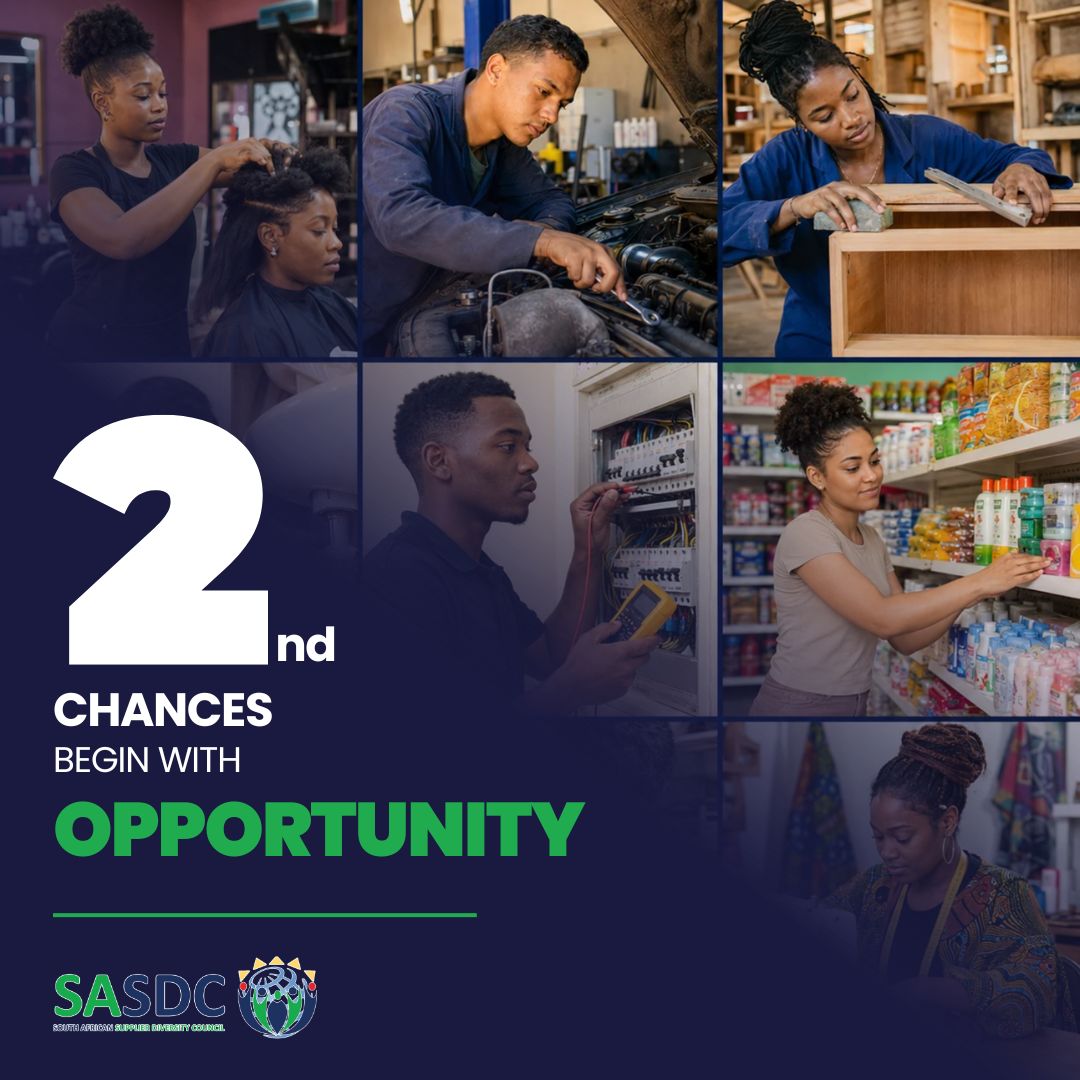
 Rehabilitation Begins with Opportunity: Why Second Chances Matter
Every person deserves the opportunity to rewrite their story.
For many young people leaving correctional facilities, the journey back into society is often shaped by barriers rather than opportunities. Finding employment can be difficult, despite having the willingness and ability to contribute positively to their communities. Without meaningful pathways to economic participation, the cycle of exclusion can continue.
This is why the partnership between the Department of Correctional Services (DCS) and the South African Supplier Diversity Council (SASDC) is so important.
Built on a shared belief that rehabilitation extends beyond incarceration, the partnership recognises that lasting change happens when people are equipped with the skills, confidence and opportunities needed to build independent and productive futures.
The Department of Correctional Services has long recognised education, skills development and rehabilitation as central to successful reintegration. Through vocational and occupational training, young offenders are equipped with practical skills that prepare them for life beyond correctional facilities.
SASDC complements this work by introducing entrepreneurship as another pathway to economic participation. Through the Cadet Intrapreneur Entrepreneur Programme, participants develop entrepreneurial thinking, financial literacy, business planning, problem-solving and opportunity recognition. These are skills that not only support employment but also empower individuals to create businesses, generate income and ultimately create opportunities for others.
Together, the partnership goes beyond preparing young people for jobs. It helps prepare them to become entrepreneurs, innovators and active contributors to South Africa's economy.
At the heart of this collaboration is a simple but powerful belief. People should not be defined by their past, but by their potential.
For many participants, the programme is about far more than acquiring new knowledge. It is about rebuilding confidence, restoring dignity and recognising that they still have something valuable to contribute. It provides the foundation to imagine a different future, one where they can support themselves, their families and their communities.
The impact of this work is already becoming evident. To date, 99 offenders and 10 Department of Correctional Services Skills Development Practitioners have successfully completed the Entrepreneurial Skills Programme, with a further 40 offenders and five officials currently participating. These numbers represent more than programme completions. They represent lives being equipped with new possibilities.
This partnership also highlights an important truth. Rehabilitation cannot be achieved by government alone.
Creating meaningful second chances requires collaboration between the public sector, private sector and civil society. When organisations invest in skills development, entrepreneurship and economic inclusion, they are doing more than changing individual lives. They are contributing to safer communities, stronger local economies and a more inclusive South Africa.
The partnership between DCS and SASDC demonstrates what is possible when organisations unite around a common purpose. By combining rehabilitation with economic opportunity, they are creating pathways for young people to move forward with confidence, dignity and hope.
Because real rehabilitation begins when people are given the opportunity to build a future, not simply leave their past behind.
Published: 03 August 2026